

Frequently Asked Questions
Non-Hotfix rhinestones require liquid or gel adhesive to apply, typically from a tube or syringe. Hotfix rhinestones come with a dry heat-activated adhesive on the back and are applied using a heat press or household iron.
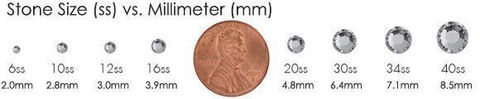
"SS" stands for Stone Size. At Sparkles Rhinestones, we carry sizes from SS10 to SS50 and beyond. The smaller the number, the smaller the stone. Stone size correlates to millimeters. You can reference our comparison chart below for visual guidance next to a U.S. penny.
Apply Hotfix rhinestones using a heat press at 360°F for 15–20 seconds. For household irons, larger stones, or rhinestone letters, additional time may be required. For complete instructions, view our application guide.
Our rhinestones are primarily made of precision-cut glass for superior sparkle and durability. We also offer Resin, Acrylic, and Faux Pearl stones made from high-quality polymers, as well as Rhinestuds and Nailheads crafted from metal.
Our Ultra or Machine Cut (MC) rhinestones are ideal for costumes. With extra facets, they reflect more light, delivering maximum sparkle—perfect for stage and performance settings.
Start with the basics: rhinestones, adhesive, and a precision tool like tweezers. Plan your design in advance, and begin with a small project to get comfortable. Most importantly, have fun and experiment!
Yes! Sparkles Rhinestones offers custom motifs with a minimum order of 25 pieces. Learn more on our Custom Motifs page.
Hand wash garments in cold water with mild detergent and air dry out of direct sunlight. For machine washing, turn items inside out, use a gentle cold cycle, and place them in a garment bag. Always air dry.
AB stands for Aurora Borealis. These rhinestones have a special coating that reflects light to create a rainbow effect, similar to the Northern Lights.
A"Gross" equals 144 rhinestones. Most of our packaging is sold by the gross, unless stated otherwise.
For fabric, use fabric glue. For hard surfaces, a strong craft glue like E6000 works best. Apply glue to the back of the stone—not the surface—for better control. Use a toothpick or precision tip to avoid overflow.